
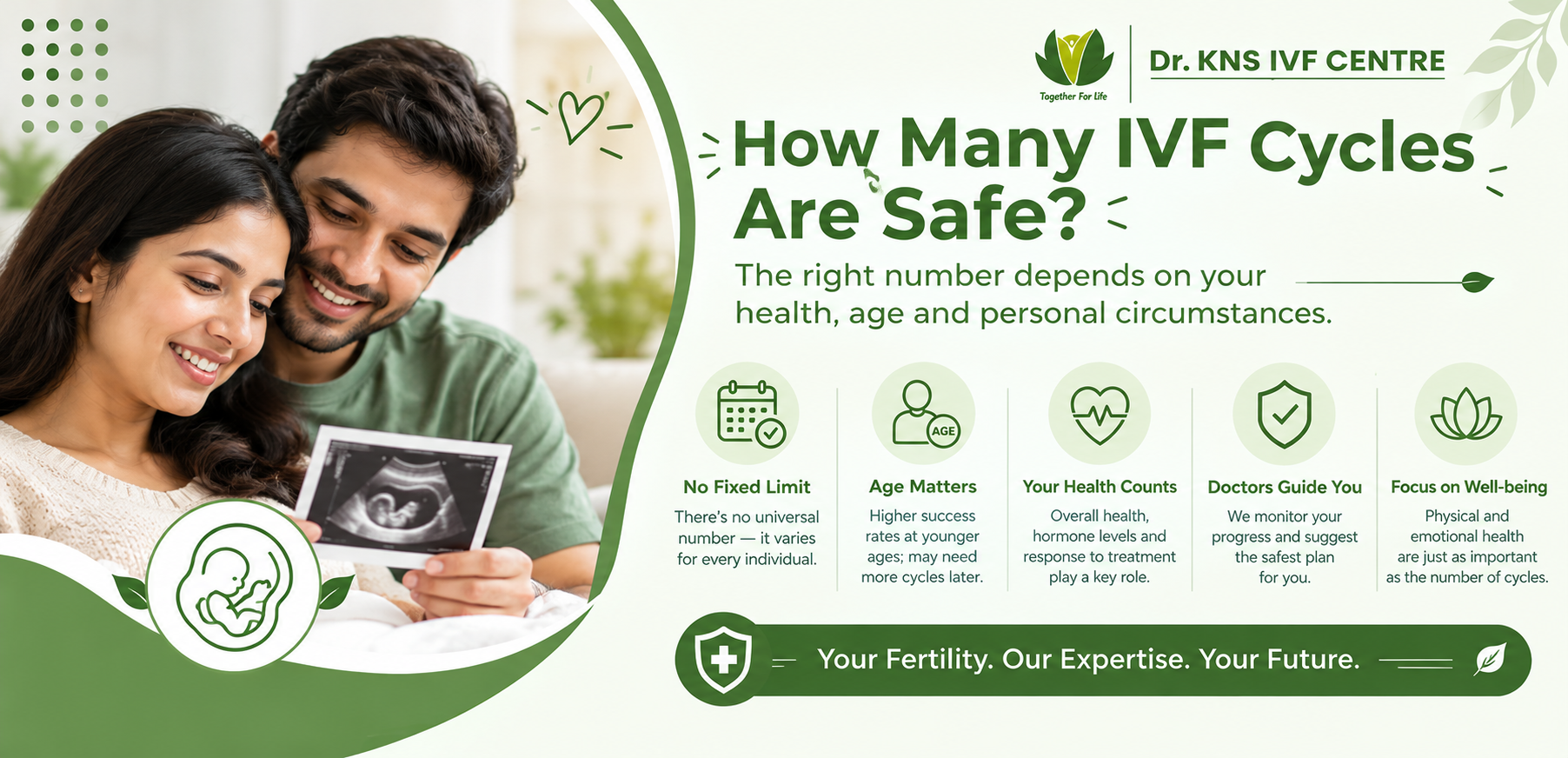
How Many IVF Cycles Can You Have?
Ask ten couples this question and you may get ten different answers, because there is no single number that fits everyone. Doctors do not hand out a fixed quota. They look at your body, your reports and how each earlier cycle responded to treatment.
That is why couples keep asking how many times IVF can be done, and why the honest reply usually begins with "it depends". For many, the realistic plan is about three complete cycles. Australian data shows most live births in younger women arrive within those first three, and the gains after that get smaller.
So the more relevant question is not about a ceiling but about whether the next go-around is worth it? If the embryos are getting better and you're doing well, a second try is definitely reasonable. If they're not, then a different approach is typically preferable to repeating the same one.
How Many Times Can IVF Be Done?
There is no "medical ceiling" that applies to all women. Some women will get pregnant on their first cycle, others will require four or five. Most doctors would recommend a few well monitored cycles, with a full assessment following each. The final figure will be dictated by the woman's age, egg quality and what the previous cycles showed.
How Many Times Can You Do IVF in a Year?
Physically, two or even three cycles in a year can be done, especially when frozen embryo transfers are involved, since they need less recovery than a fresh stimulation. But possible and advisable are not the same thing. Your doctor will usually space out stimulation cycles to protect your ovaries and your energy.
Is There a Fixed Limit to IVF Cycles?
Not in the way most people imagine. Guidelines focus on safety and benefit rather than a magic number. When repeated cycles stop giving new information or better embryos, doctors tend to pause and rethink. The limit, if you want to call it one, is the point where more attempts stop adding real hope.
Is It Safe to Have Multiple IVF Cycles?
For most healthy women, yes. Studies that followed women through several rounds have not found a clear rise in serious long term problems from repeated treatment alone. Still, "generally safe" does not mean "free of cost".
Every cycle asks something from your body, your mind and your savings.
The hormone injections can make you feel very bloated, moody and tired. The egg collection is a minor procedure performed under sedation. If you have 3 or 4 of them in a row you will definitely feel the effects. It's important to take into consideration how long between each cycle you are having, as well as how many you are having. Many women also become worried about how successful their IVF is going to be, which can cause stress.
What keeps treatment safe is not luck. It is personalised dosing, regular scans, blood tests and a doctor who is ready to say "let us skip this month". Talk about your worries openly before the next cycle, not after it.
What Happens During an IVF Cycle?
All of that starts with 10–12 days of hormone injections, which stimulate the growth of multiple follicles. They are monitored on scans and a trigger shot is used to mature the eggs. The eggs are retrieved and fertilised in the lab, then are grown for three to five days. One healthy embryo is selected to be transferred into the womb that day or frozen.
Possible Risks of Repeated IVF Cycles
The risks are minor but genuine. Ovarian hyperstimulation can lead to swollen, painful ovaries and, occasionally, require hospital treatment. Multiple cycles can exhaust some women's ovaries so their response to stimulation diminishes over time. Excess bleeding, infection or sedation issues following egg collection are rare. For some people, the emotional effects of stress, expenses and frustration following a failed cycle can outweigh the medical effects.
Why Medical Monitoring Matters During IVF
Monitoring keeps a risky plan safe. Scans and hormone test results indicate your response, allowing dosing to be changed early on. It also prevents overstimulation, and indicates the safe number of IVF cycles, for you.
How Long Should You Wait Between IVF Cycles?
Long enough for your body to settle, and not so long that you lose precious time. For most women that means one to three months after a stimulation cycle, though your doctor may suggest a different gap after checking your scans and reports.
Think of it as a reset. Your ovaries need to return to normal size, your hormones need to calm down and your periods should become regular again. Your mind needs a breather too, and that part is easy to ignore.
It further determines how many sessions a year equals out to be, which is the reason everyone has been searching for "how many times can you do IVF in a year" on Google.
Recovery After an IVF Cycle
Most women feel normal within a week or two of egg collection. Bloating, mild cramps and tiredness are common early on. The next period usually arrives ten to fourteen days later. Sharp pain deserves a call to the clinic.
When Can You Start Another IVF Cycle?
Many clinics will let you restart after a failed fresh cycle after one or two normal periods. Frozen transfer is often possible in the very next cycle. Closer spacing is also good for safeguarding the IVF success rate of subsequent trials.
Why the Waiting Period May Differ for Each Patient
Age, ovarian response and past complications all change the advice. A woman in her late thirties may be told to move faster, while someone who had overstimulation may need extra time.
How Successful Is IVF?
Anyone who quotes you one big number is skipping the details. In the latest Australia and New Zealand report, about 37 percent of women had a baby from their very first cycle, and that figure climbs with every extra attempt for younger women.
Victorian data from women who started treatment in 2016 and 2017 makes the point clearly. Among women under 30, 43 percent had a baby after one cycle and 66 percent after three. For women aged 40 to 41, the numbers were 13 and 25 percent.
That gap is mostly a story about eggs and age, not about clinics or luck. It is why a quoted IVF success rate means little until it is matched to your age, your diagnosis and the type of cycle. A question like how successful is IVF only gets a useful answer once it becomes a question about you.
Understanding IVF Success Rate
Success can mean a positive pregnancy test, a clinical pregnancy or a live birth, and they are not the same. The number that matters most is the live birth rate. It can be counted per cycle, per embryo transfer or across several cycles together, so always check which one a clinic is quoting.
IVF Success Rates by Age
Age is the strongest predictor, and the fall is steady. In the Victorian data, a woman under 30 had a 43 percent chance after one cycle. That dropped to 32 percent at 36 to 37, 22 percent at 38 to 39 and just 6 percent at 42 to 43. Donor eggs change the picture, since the result then follows the donor's age.
Does IVF Success Change With Multiple Attempts?
Usually for the better, up to a point. Each cycle adds to the overall chance, but the gain shrinks. For women under 30, the second cycle added about 16 points, while the third added only about 7. Hope stays, but expectations get more realistic.
What Is the Embryo Transfer Success Rate?
The transfer is the moment everyone waits for. The embryo transfer success rate is the chance that one transfer leads to a pregnancy that continues, which is a different thing from the success of a whole cycle.
For women under 35 with a good blastocyst, clinics often quote somewhere around 40 to 50 percent per transfer. It slips as age rises and can fall below 10 percent after 42. Treat these as ballparks.
Your own number comes from the embryo and the womb working together. A healthy embryo still needs a receptive lining and well planned timing. When both line up, the embryo transfer success rate improves, and when one is off, even the best embryo can fail.
Factors That Affect Embryo Transfer Success
- The woman's age when the eggs were collected
- Embryo grade and how far it has developed
- Thickness and receptivity of the uterine lining
- Fibroids, polyps, endometriosis or fluid in the fallopian tubes
- Timing, technique and calm handling during the transfer
- Smoking, body weight and stress levels in daily life
Does Embryo Quality Affect IVF Success?
Very much. Embryos that reach the blastocyst stage with a good grade are more likely to implant. Chromosomally normal embryos do better still, and genetic testing is sometimes used. Grading is only a guide though, and some lower grade embryos become healthy babies.
Fresh vs Frozen Embryo Transfer
Neither wins for everyone. Frozen transfers give the body time to recover and often suit women at risk of overstimulation, while fresh transfers can work well when hormones are balanced.
When Should You Consider Another IVF Cycle?
When you are ready in body, mind and plan. Not a day earlier because of pressure, and not a year later out of fear.
After a failed cycle, most doctors want a proper debrief first. How many eggs came out, how many fertilised, how the embryos grew and what the lining looked like. These answers decide whether to repeat the same plan or change it.
Another cycle makes sense when there is something to build on, like decent embryo quality or a clear problem that can be fixed. Age nudges the timing too, and the clock matters. With the IVF success rate falling after 38, waiting too long has a price of its own, so the review should happen quickly.
After an Unsuccessful IVF Cycle
Give yourself a few days, honestly. Then book a review. Ask about embryo grades, any frozen embryos left and whether tests like endometrial or genetic screening could help. Couples often need counseling too, and asking for it is a sign of sense, not weakness.
When Your Doctor May Modify the Treatment Plan
If the same protocol gave poor results, the plan may change. Doctors might adjust doses, extend embryo culture to the blastocyst stage, add genetic testing, try assisted hatching or move to a freeze-all cycle. Fixing a thin lining or infection first can lift the embryo transfer success rate.
When Other Fertility Options May Be Discussed
After several unsuccessful cycles, your doctor may bring up donor eggs, donor sperm, a gestational carrier or adoption. These talks are about options, never about giving up on parenthood.
What Factors Affect the Number of IVF Cycles You May Need?
Two couples can start on the same day and finish very differently. Some need one cycle, others need four, and neither is doing anything wrong.
The big drivers are the woman's age, how many good eggs she makes, sperm quality, the health of the womb and what earlier cycles showed. Smoking, weight and stress play a smaller but real part, and so does how your body responds to medicines.
No clinic can promise a number upfront, but it can give a fair range after tests like AMH, antral follicle count and semen analysis. That range is your personal answer to how many times IVF can be done, and it beats any general rule.
Age and Ovarian Reserve
Age sets the pace. After 35, egg numbers and quality fall faster, which is why IVF success rates by age differ so much. AMH and antral follicle count help estimate how many eggs remain.
Egg and Embryo Quality
Quality matters more than quantity. A woman with fewer eggs can still get a healthy embryo, while many eggs may give none. Poor quality often means more cycles, because several attempts may be needed to collect even one embryo fit for transfer.
Previous IVF Outcomes and Medical History
Past cycles are a roadmap. Poor fertilisation, failed implantation or early miscarriage point to different causes. Conditions like PCOS, endometriosis, thyroid problems or low sperm count also shape the plan, so share your full history.